My Reading Life: The Cloister Walk (Norris)
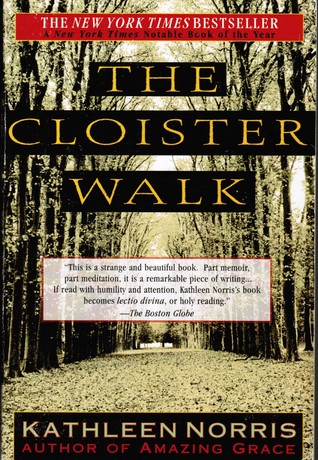
The Cloister Walk
followed my reading of In This House of
Brede (here) to blend and bond this new introduction of monastic life to my understanding.
While one is fiction, the other is reality.
I’m not sure how I came to be interested in this book, but I’d say it had to do
with the image the word cloister
brought to my mind – walking the cloister of Salisbury Cathedral in 2012. Even amidst
throngs of others visiting the cathedral that day, there still existed a
quietness, a solemnity, even a solitude in the cloister. The architectural
effect of the hard, ancient stones under foot and over head, offered coolness
and shade, while the carved curves of the vertical stones became the windows of
creation beauty of the landscaped green. Thus I embarked upon The Cloister Walk.
but I’d say it had to do
with the image the word cloister
brought to my mind – walking the cloister of Salisbury Cathedral in 2012. Even amidst
throngs of others visiting the cathedral that day, there still existed a
quietness, a solemnity, even a solitude in the cloister. The architectural
effect of the hard, ancient stones under foot and over head, offered coolness
and shade, while the carved curves of the vertical stones became the windows of
creation beauty of the landscaped green. Thus I embarked upon The Cloister Walk.
I’m not sure how I came to be interested in this book,
 but I’d say it had to do
with the image the word cloister
brought to my mind – walking the cloister of Salisbury Cathedral in 2012. Even amidst
throngs of others visiting the cathedral that day, there still existed a
quietness, a solemnity, even a solitude in the cloister. The architectural
effect of the hard, ancient stones under foot and over head, offered coolness
and shade, while the carved curves of the vertical stones became the windows of
creation beauty of the landscaped green. Thus I embarked upon The Cloister Walk.
but I’d say it had to do
with the image the word cloister
brought to my mind – walking the cloister of Salisbury Cathedral in 2012. Even amidst
throngs of others visiting the cathedral that day, there still existed a
quietness, a solemnity, even a solitude in the cloister. The architectural
effect of the hard, ancient stones under foot and over head, offered coolness
and shade, while the carved curves of the vertical stones became the windows of
creation beauty of the landscaped green. Thus I embarked upon The Cloister Walk.
A good synopsis of The Cloister Walk is from the back book
cover:
Part record of her
time among the Benedictines, part meditation on various aspects of monastic
life, The Cloister Walk demonstrates,
from the rare perspective of someone who is both an insider and outsider, how
immersion in the cloistered world– its liturgy, its ritual, its sense of
community– can impart meaning to everyday events and deepen our secular lives.
In this stirring and lyrical work, the monastery, often considered archaic or
otherworldly, becomes immediate, accessible, and relevant to us, no matter what
our faith may be.
The
book was a bit draggy for me, but maybe that’s part of the point. Nevertheless,
I marked several quotes that stood out to me.
“Benedict’s
language and imagery come from the Bible, but he was someone who read the
psalms every day – as Benedictines still do – something of the psalms’
emotional honesty, their grounding in the physical, rubbed off on him.”
This
reminded me of a dear friend who regularly reads five of the Psalms a day. And
then toward the end of the book, Norris says,
“One of the goals
of monastic life is to let the psalms become so much a part of one’s
consciousness that they surface unexpectedly, in respond to the circumstances
of daily life. . . . It is the aim of
contemplative living, at least in the Christian mode, that you learn to recognize
a blessing when you see one, and are able to respond to it with words that God
has given you.”
I’ve
long used the word “intentional” about many things I do, and I think I should
add the word “contemplative” also.
I remember when I
was a 9-10 year old, how our grocery had, at most, three three-foot shelves of
cereal. And how today, the store aisle must be five 100 feet shelves bulging
with different cereals. Not surprisingly, this thought stood out:
“ ‘How many kinds
of cereals do we need, he asked, ‘in order to meet genuine health needs without
falling into thoughtless consumerism?’ ”
And
the quote of St. Augustine was delightful:
“Let us sing now,
not in order to enjoy a life of leisure, but in order to lighten your labors.
You should sing as wayfarers do – sing, but continue your journey. Do not be
lazy, but sing to make your journey enjoyable. Sing, but keep going.”
Later,
Norris shares
“I know from my
limited experience of singing chant that it fosters faith; I believe better and
more thoroughly when I’m singing it. . . .The flow of Gregorian music reminds
me of the pulse of ocean waves, steady and incessant, but never superfluous, a
satisfying sound that my swell unpredictable before ebbing back into silence.”
And
this:
“The sister
compared the Liturgy of the Hours to housework, as repetitive work that is
never done, but work that Benedictines keep coming back to because it forms the
individual person and also maintains the fabric of the community.”


